
SEO Needs More Than Traffic: Businesses Need to Look at Pipeline.
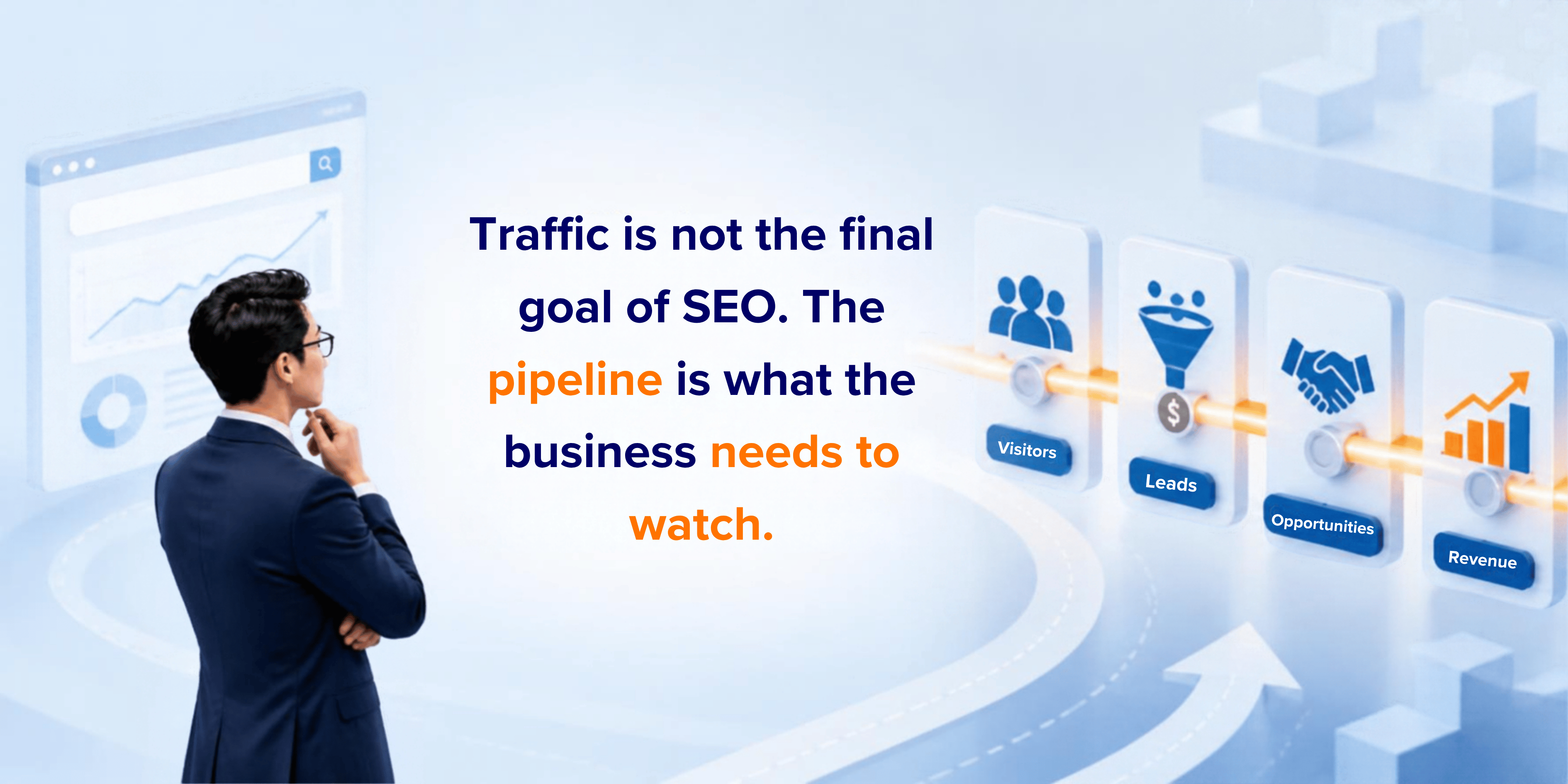
Traffic is not the ultimate goal of SEO. Pipeline is what businesses need to look at. This is a question worth pausing to consider for any business owner, because a B2B SEO case study is not just a concept to learn about. In today's competitive environment, how a business understands and implements this topic directly affects its ability to generate demand, build trust, and convert opportunities into revenue. In B2B, this is even more evident because customers often have multiple people involved in the decision-making process, long buying cycles, and higher requirements for evidence. This article moves from the fundamentals to practical application while connecting B2B SEO case studies with growth objectives. Instead of viewing Marketing as a list of tasks, AME's approach is to look at the entire system from positioning, Content, channels, and data to Sales. This is also the foundation for helping businesses avoid doing many things without knowing which activities are actually creating value.
SEO Audit
When discussing SEO Audit, businesses should look at the issue from both the customer's perspective and business objectives. In B2B, trust is a major variable. Business customers often need to review the Website, company profile, expert Content, Case Studies, how the team responds, and evidence of processes before they are ready to provide information or speak with Sales. Therefore, a strong system must not only generate reach but also accumulate evidence and reduce the buyer's perceived risk.
Practical Understanding for B2B Businesses
Businesses should also avoid judging performance too early based on a single metric. A piece of Content may have few views but attract the right decision-makers; a Campaign may have a higher CPL but create more sales opportunities; an SEO program may not generate revenue immediately but may be accumulating rankings and high-quality search demand. The right way to read the data is to place each metric in the context of the Funnel and Sales Cycle.
How to Implement
To implement this section, businesses can use a simple process: define objectives, identify priority customer groups, align messaging, select appropriate assets/channels, set KPIs, and create a data feedback mechanism. With B2B SEO case studies, the most important thing is not to separate individual activities from the Funnel. Every activity should be able to answer whether it is helping customers understand the problem, trust the solution, provide their information, or move toward a sales opportunity.
For example, a B2B business can start with Content that explains the problem at the top of the Funnel, then guide readers to in-depth materials or a Case Study, and use a Landing Page to collect information. When Sales receives a Lead, data about call quality is fed back to Marketing to adjust the ICP, messaging, and Campaign. This feedback loop is what ensures that B2B SEO case studies do not remain purely theoretical.
Keyword Strategy

When discussing Keyword Strategy, businesses should look at the issue from both the customer's perspective and business objectives. A practical approach is to divide the system into three layers: foundation, acquisition, and conversion. The foundation includes positioning, ICP, messaging, and digital assets. Acquisition includes SEO, Content, Social, advertising, and outreach channels. Conversion includes Landing Pages, Forms, CRM, Lead qualification processes, SLAs with Sales, and Pipeline tracking mechanisms. When these three layers are connected, Marketing becomes a system rather than a collection of disconnected tasks.
Practical Understanding for B2B Businesses
In practice, many businesses view this issue from the perspective of tools rather than business outcomes. As a result, teams can easily focus on "doing more" without knowing whether those activities are actually moving customers closer to a purchase decision. In B2B, the distance between a Marketing activity and a contract is often quite long, so every activity needs to be tied to a specific objective in the Customer Journey.
How to Implement
To implement this section, businesses can use a simple process: define objectives, identify priority customer groups, align messaging, select appropriate assets/channels, set KPIs, and create a data feedback mechanism. With B2B SEO case studies, the most important thing is not to separate individual activities from the Funnel. Every activity should be able to answer whether it is helping customers understand the problem, trust the solution, provide their information, or move toward a sales opportunity.
Topic Cluster
When discussing Topic Clusters, businesses should look at the issue from both the customer's perspective and business objectives. Businesses should also avoid judging performance too early based on a single metric. A piece of Content may have few views but attract the right decision-makers; a Campaign may have a higher CPL but create more sales opportunities; an SEO program may not generate revenue immediately but may be accumulating rankings and high-quality search demand. The right way to read the data is to place each metric in the context of the Funnel and Sales Cycle.
Practical Understanding for B2B Businesses
The key is to start with business questions: which segment does the business want to grow in, how many additional sales opportunities does it want to create, and which customer groups are the most valuable? Once these questions are clear, Marketing has a basis for choosing messages, Content, channels, and KPIs. If done in reverse, businesses can easily end up with plenty of data but no shared answer about effectiveness.
How to Implement
To implement this section, businesses can use a simple process: define objectives, identify priority customer groups, align messaging, select appropriate assets/channels, set KPIs, and create a data feedback mechanism. With B2B SEO case studies, the most important thing is not to separate individual activities from the Funnel. Every activity should be able to answer whether it is helping customers understand the problem, trust the solution, provide their information, or move toward a sales opportunity.
For example, a B2B business can start with Content that explains the problem at the top of the Funnel, then guide readers to in-depth materials or a Case Study, and use a Landing Page to collect information. When Sales receives a Lead, data about call quality is fed back to Marketing to adjust the ICP, messaging, and Campaign. This feedback loop is what ensures that B2B SEO case studies do not remain purely theoretical.
Content
When discussing Content, businesses should look at the issue from both the customer's perspective and business objectives. In practice, many businesses view this issue from the perspective of tools rather than business outcomes. As a result, teams can easily focus on "doing more" without knowing whether those activities are actually moving customers closer to a purchase decision. In B2B, the distance between a Marketing activity and a contract is often quite long, so every activity needs to be tied to a specific objective in the Customer Journey.
Practical Understanding for B2B Businesses
In B2B, trust is a major variable. Business customers often need to review the Website, company profile, expert Content, Case Studies, how the team responds, and evidence of processes before they are ready to provide information or speak with Sales. Therefore, a strong system must not only generate reach but also accumulate evidence and reduce the buyer's perceived risk.
How to Implement
To implement this section, businesses can use a simple process: define objectives, identify priority customer groups, align messaging, select appropriate assets/channels, set KPIs, and create a data feedback mechanism. With B2B SEO case studies, the most important thing is not to separate individual activities from the Funnel. Every activity should be able to answer whether it is helping customers understand the problem, trust the solution, provide their information, or move toward a sales opportunity.
Technical SEO
When discussing Technical SEO, businesses should look at the issue from both the customer's perspective and business objectives. The key is to start with business questions: which segment does the business want to grow in, how many additional sales opportunities does it want to create, and which customer groups are the most valuable? Once these questions are clear, Marketing has a basis for choosing messages, Content, channels, and KPIs. If done in reverse, businesses can easily end up with plenty of data but no shared answer about effectiveness.
Practical Understanding for B2B Businesses
A practical approach is to divide the system into three layers: foundation, acquisition, and conversion. The foundation includes positioning, ICP, messaging, and digital assets. Acquisition includes SEO, Content, Social, advertising, and outreach channels. Conversion includes Landing Pages, Forms, CRM, Lead qualification processes, SLAs with Sales, and Pipeline tracking mechanisms. When these three layers are connected, Marketing becomes a system rather than a collection of disconnected tasks.
How to Implement
To implement this section, businesses can use a simple process: define objectives, identify priority customer groups, align messaging, select appropriate assets/channels, set KPIs, and create a data feedback mechanism. With B2B SEO case studies, the most important thing is not to separate individual activities from the Funnel. Every activity should be able to answer whether it is helping customers understand the problem, trust the solution, provide their information, or move toward a sales opportunity.
For example, a B2B business can start with Content that explains the problem at the top of the Funnel, then guide readers to in-depth materials or a Case Study, and use a Landing Page to collect information. When Sales receives a Lead, data about call quality is fed back to Marketing to adjust the ICP, messaging, and Campaign. This feedback loop is what ensures that B2B SEO case studies do not remain purely theoretical.
Internal Link
When discussing Internal Links, businesses should look at the issue from both the customer's perspective and business objectives. In B2B, trust is a major variable. Business customers often need to review the Website, company profile, expert Content, Case Studies, how the team responds, and evidence of processes before they are ready to provide information or speak with Sales. Therefore, a strong system must not only generate reach but also accumulate evidence and reduce the buyer's perceived risk.
Practical Understanding for B2B Businesses
Businesses should also avoid judging performance too early based on a single metric. A piece of Content may have few views but attract the right decision-makers; a Campaign may have a higher CPL but create more sales opportunities; an SEO program may not generate revenue immediately but may be accumulating rankings and high-quality search demand. The right way to read the data is to place each metric in the context of the Funnel and Sales Cycle.
How to Implement
To implement this section, businesses can use a simple process: define objectives, identify priority customer groups, align messaging, select appropriate assets/channels, set KPIs, and create a data feedback mechanism. With B2B SEO case studies, the most important thing is not to separate individual activities from the Funnel. Every activity should be able to answer whether it is helping customers understand the problem, trust the solution, provide their information, or move toward a sales opportunity.
Conversion, Lead, and Pipeline
When discussing Conversion, Lead, and Pipeline, businesses should look at the issue from both the customer's perspective and business objectives. A practical approach is to divide the system into three layers: foundation, acquisition, and conversion. The foundation includes positioning, ICP, messaging, and digital assets. Acquisition includes SEO, Content, Social, advertising, and outreach channels. Conversion includes Landing Pages, Forms, CRM, Lead qualification processes, SLAs with Sales, and Pipeline tracking mechanisms. When these three layers are connected, Marketing becomes a system rather than a collection of disconnected tasks.
Practical Understanding for B2B Businesses
In practice, many businesses view this issue from the perspective of tools rather than business outcomes. As a result, teams can easily focus on "doing more" without knowing whether those activities are actually moving customers closer to a purchase decision. In B2B, the distance between a Marketing activity and a contract is often quite long, so every activity needs to be tied to a specific objective in the Customer Journey.
How to Implement
To implement this section, businesses can use a simple process: define objectives, identify priority customer groups, align messaging, select appropriate assets/channels, set KPIs, and create a data feedback mechanism. With B2B SEO case studies, the most important thing is not to separate individual activities from the Funnel. Every activity should be able to answer whether it is helping customers understand the problem, trust the solution, provide their information, or move toward a sales opportunity.
For example, a B2B business can start with Content that explains the problem at the top of the Funnel, then guide readers to in-depth materials or a Case Study, and use a Landing Page to collect information. When Sales receives a Lead, data about call quality is fed back to Marketing to adjust the ICP, messaging, and Campaign. This feedback loop is what ensures that B2B SEO case studies do not remain purely theoretical.
Common Mistakes Businesses Make
The most common mistake is turning a B2B SEO case study into a checklist of tasks: publishing posts, running Ads, producing videos, writing SEO Content, and then expecting revenue to appear automatically. The second mistake is choosing KPIs that are easy to see but far removed from business outcomes. The third mistake is a lack of alignment between Marketing and Sales, leaving the business unable to determine which Leads are truly good and why some opportunities convert while others do not.
Another mistake is changing tactics too quickly. B2B has a long buying cycle, so some activities need time to build trust. Businesses should establish clear evaluation thresholds, monitor intermediate signals, and only make changes when there is enough data to show that the original hypothesis is incorrect.
AME's Perspective: From Disconnected Activities to a Growth System
AME approaches B2B SEO case studies with systems thinking: starting with Business Goal and ICP, then defining Positioning, Content, Channel, Media, and Measurement. The goal is not to use the most channels possible, but to make those channels support the same Customer Journey. When data from Website, Ads, SEO, Content, CRM, and Sales is connected, businesses can clearly see where demand is being created, where opportunities are leaking, and where additional investment is needed.
If a business is currently exploring B2B SEO case studies, the next step should be to assess the current state rather than rushing to add more channels. Check whether the brand has a clear ICP, whether the messaging accurately reflects customer problems, whether the Website supports Conversion, whether KPIs connect to Pipeline, and whether Sales feeds data back to Marketing. The answers to these questions will determine the next priorities.
Frequently Asked Questions
Are B2B SEO case studies suitable for small businesses?
Yes. Small businesses need to prioritize even more carefully because resources are limited. The key is to choose a clear segment, a strong message, and a few channels capable of creating significant impact rather than spreading resources too thin.
How long does it take to see results from B2B SEO case studies?
There is no single timeline that applies to every business. Activities such as Ads may provide early signals, while SEO, brand building, and B2B Content require time to accumulate results. Performance should be evaluated through intermediate milestones such as Traffic quality, MQL, SQL, and Pipeline.
Which channel should businesses start with?
Start where target customers are researching and making decisions. For many B2B businesses, Website, SEO, expert Content, LinkedIn, Google Ads, or Email are often channels worth considering, but the final choice should be based on ICP and Sales Cycle.
Which metrics should businesses track?
At minimum, businesses should track metrics across the Funnel: Traffic/reach quality, Conversion, MQL, SQL, Opportunity, Pipeline, and revenue. Communication metrics are still useful, but they need to be placed within this logical chain.
Next Step
Register for a B2B SEO consultation. Instead of continuing to add more disconnected activities, businesses should clearly identify the next step in the Funnel and measure whether it improves the quality of sales opportunities. That is how Marketing knowledge becomes a manageable growth capability.